02 / Selected work
Scientific ML
ML-guided polymer discovery loop
A didactic scientific study that uses physics-informed synthetic data and surrogate models to decide which formulations deserve a lab budget.
Python · NumPy · pandas · scikit-learn · matplotlib
Context
polymer-ml-lab is a public, notebook-led study. It is not an industrial R&D deployment and it does not use proprietary lab measurements. The premise is scientific and didactic: use ML to shrink a theoretical search space before anyone spends experimental budget.
This is the clearest public bridge from physics engineering to data systems: constraints first, then measurement (even if simulated), then a decision.
Problem
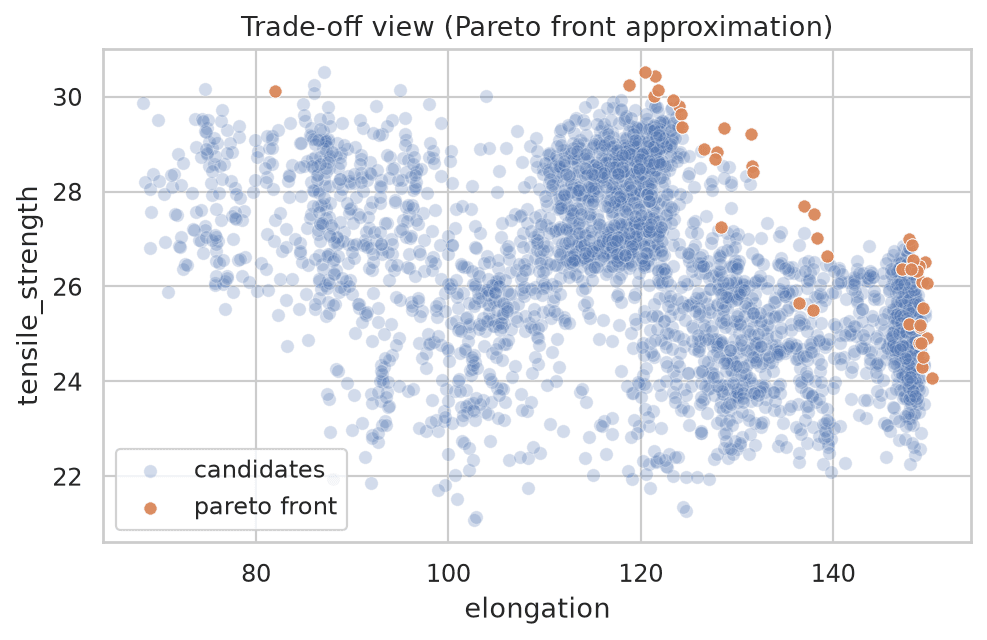
Formulation spaces are large. Tensile strength, elongation, and thermal resistance pull in different directions. A team that tests at random burns time. A team that only follows folklore may never see the Pareto surface. The project asks how to propose a small set of candidates that are physically plausible and worth confirming.
Architecture
The documented loop:
- Define a constrained formulation sandbox (base, additives, process variables, mass balance ≈ 100 wt%).
- Generate pseudo-lab data with physics-inspired equations plus controlled noise.
- Train surrogates (linear baselines vs Random Forest), including a low-data regime.
- Generate candidates with constrained search and Upper Confidence Bound (UCB) scoring.
- Simulate measuring those candidates, append, retrain, watch the Pareto front.
Code is split between ordered notebooks (01 data generation, 02 modeling, 03 optimization) and src/data_generation.py so sampling is not trapped in a notebook.
Data / inputs
There is no confidential polymer dataset. Bounds, samplers, and a lab-simulation helper live in code. Generated tables can be cached locally and are gitignored by default. Trends the README expects: filler raises tensile strength and hurts elongation; plasticizer does the opposite; temperature has a bell-shaped optimum.
Engineering decisions
- Physics in the generator, not as a vibe. Mass balance and process limits are encoded so the model cannot recommend nonsense formulations as freely.
- Baselines before clever models. Linear models sit next to Random Forest so “ML helped” is comparable, not theatrical.
- Uncertainty-aware reading of low-data regimes. The write-up emphasizes not trusting overconfident recommendations when samples are few.
- UCB as the decision policy. Exploration versus exploitation is explicit: the loop is allowed to visit novel regions, not only the current best.
- Notebooks as lab books. Each notebook ends with notes pointing to the next step. Reproducibility is the product.
Implementation
Environment: NumPy, pandas, scikit-learn, matplotlib, seaborn. Run notebooks in order, or call python -m src.data_generation. A helper strips notebook outputs before version control so diffs stay readable.
Challenges
- Synthetic data only approximates a lab. The README is clear: real measurements should replace or fine-tune the same notebooks (Gaussian processes are listed as a future surrogate).
- Optimization is heuristic search, not a full Bayesian optimization stack. That is an honest limitation, not a hidden one.
- Extra industrial constraints (cost, aging, rheology) are named as missing, not silently assumed.
Results
From the project README, as a synthetic study, not a factory trial:
- Random Forest surrogates stayed robust when data was throttled to about 20–30 samples.
- The UCB loop narrowed the Pareto front in roughly three iterations.
- On the order of the top ~5% of theoretical candidates would be sent to the (simulated) lab.
I will not translate those figures into “we cut lab cost by X% at company Y.”
What I learned
Measure before optimizing: even in a toy loop, you compare a linear baseline and you watch uncertainty. Systems > tools: the value is the closed loop (generate → score → choose → measure), not the choice of forest versus network.
Grain matters here too. A formulation vector is not a recommended experiment until it has survived constraints and a policy. Mixing those grains is how a notebook becomes an overconfident slide.
Stack
Python, NumPy, pandas, scikit-learn, matplotlib, seaborn, Jupyter.